

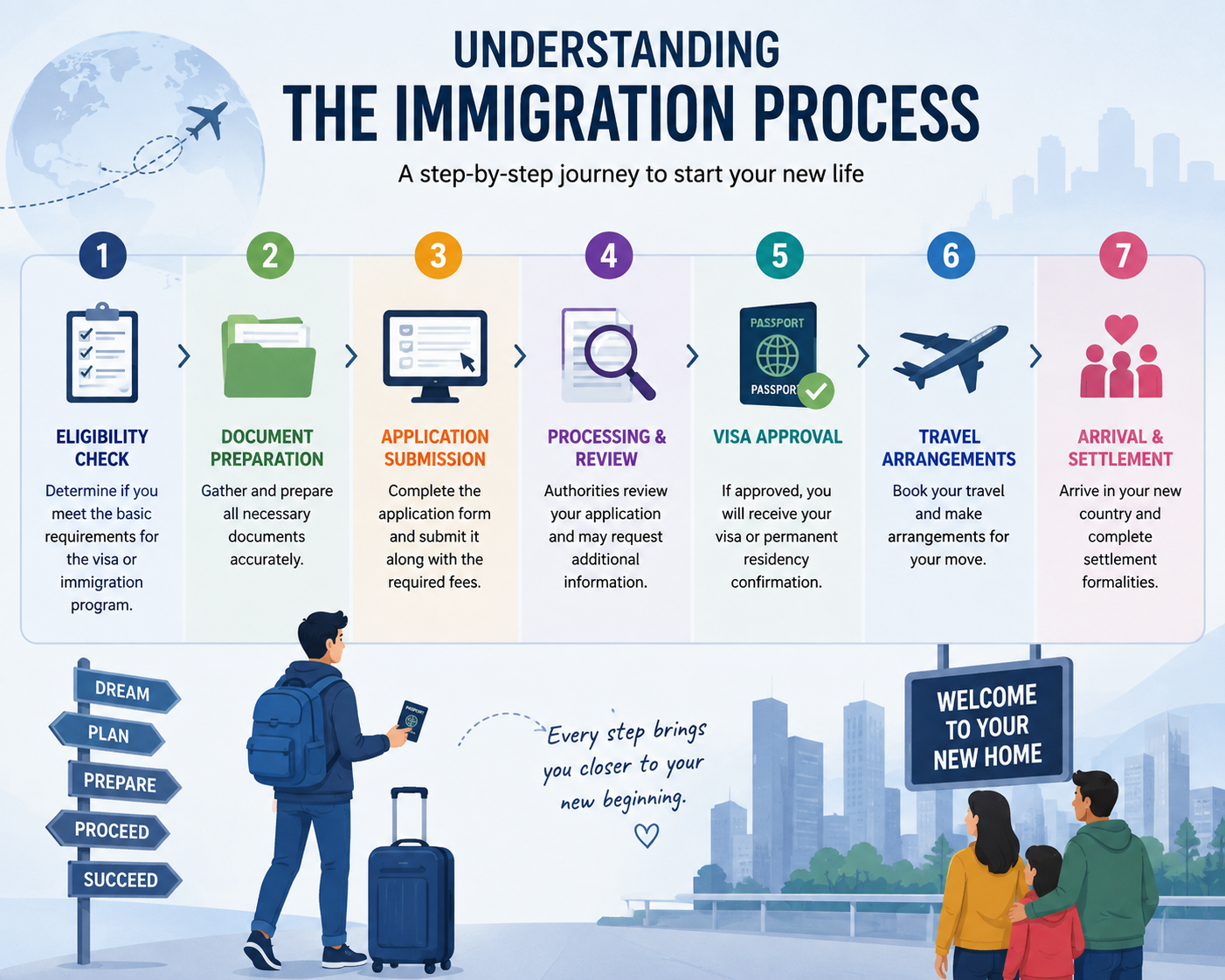
Immigration is the legal process through which a person enters, stays in, or seeks a long-term status in another country. Depending on the destination country and the person’s circumstances, immigration may involve temporary visas, permanent residence, family sponsorship, employment-based applications, humanitarian protection, or citizenship.
Immigration law can be complicated because requirements vary by country and can change over time. Applications may require extensive documentation, background checks, interviews, medical examinations, financial evidence, and strict deadlines.
This guide explains the general stages of the immigration process and the issues applicants should understand before submitting an application.
What Is Immigration?
Immigration generally refers to moving from one country to another with the intention of living, working, studying, visiting, or obtaining another legally recognized status.
Different immigration categories serve different purposes.
For example, a person may enter another country for:
- Tourism
- Education
- Employment
- Family reunification
- Business
- Permanent residence
- Humanitarian protection
Each category has its own requirements and restrictions.
Temporary and Permanent Immigration Status
One of the first distinctions applicants should understand is the difference between temporary and permanent status.
Temporary status allows a person to remain in a country for a specified purpose and period.
Examples may include:
- Visitor status
- Student status
- Temporary employment
- Business travel
- Temporary family-related visas
Permanent immigration status generally provides a longer-term right to live in a country, subject to the applicable law.
Permanent residents may eventually qualify for citizenship if they meet specific requirements.
Choosing the Correct Immigration Category
Selecting the correct immigration category is an important first step.
Applicants should consider:
- Purpose of travel
- Intended length of stay
- Family relationships
- Employment
- Education
- Financial circumstances
- Previous immigration history
- Eligibility requirements
Submitting an application under the wrong category can result in delays, refusal, or other complications.
Checking Eligibility
Every immigration category has eligibility requirements.
These may involve:
- Age
- Education
- Employment
- Financial resources
- Family relationships
- Sponsorship
- Qualifications
- Criminal or immigration history
- Health requirements
- Other criteria
Applicants should review the official requirements for the country and immigration category involved.
Gathering Documents
Immigration applications commonly require supporting documentation.
Documents may include:
- Passport
- Birth certificate
- Marriage certificate
- Educational records
- Employment letters
- Financial statements
- Tax documents
- Police certificates
- Photographs
- Medical records
- Sponsorship documents
The exact requirements vary.
Documents issued in another language may need certified translations depending on the application rules.
Completing the Application
Immigration forms must generally be completed accurately and consistently.
Applicants should provide information exactly as requested.
Errors involving names, dates, addresses, employment history, travel history, or family information can create problems.
Before submitting an application, applicants should carefully review all answers and supporting documents.
Paying Application Fees
Many immigration applications require government fees.
Fees vary depending on the application type and destination country.
Some applications may involve additional charges for:
- Biometrics
- Medical examinations
- Expedited processing
- Document certification
- Other required services
Applicants should confirm current fees through official government sources before submitting payment.
Biometrics
Some immigration systems require applicants to provide biometric information.
Biometrics may include:
- Fingerprints
- Photographs
- Other identity verification information
Applicants may receive instructions about where and when to provide biometrics.
Failing to attend a scheduled biometric appointment can delay an application.
Immigration Interviews
Certain immigration applications require an interview.
During an interview, an immigration officer may ask questions about:
- Purpose of travel
- Family relationships
- Employment
- Education
- Financial circumstances
- Previous travel
- Immigration history
- Application documents
Applicants should answer truthfully and consistently.
Providing false information can have serious consequences.
Background and Security Checks
Immigration authorities may conduct background checks.
These checks can involve identity verification, criminal records, previous immigration applications, security databases, or other information permitted by law.
The duration of these checks varies.
Applicants should understand that processing may take longer when additional verification is required.
Medical Examinations
Some immigration categories require a medical examination.
The examination may need to be completed by an approved medical professional.
The requirements differ depending on the country and immigration category.
Applicants should follow the official instructions rather than obtaining an examination from an unapproved provider.
Financial Requirements
Some immigration programs require applicants or sponsors to demonstrate sufficient financial resources.
Financial evidence may include:
- Bank statements
- Employment records
- Tax documents
- Salary information
- Sponsorship forms
- Business records
- Other financial evidence
The purpose may be to demonstrate that the applicant or sponsor can meet applicable financial requirements.
Family-Based Immigration
Many countries offer immigration pathways based on qualifying family relationships.
Depending on local law, eligible relationships may include:
- Spouses
- Parents
- Children
- Certain other relatives
Family-based immigration can involve sponsorship and evidence demonstrating that the relationship is genuine and legally recognized.
Employment-Based Immigration
Employment-based immigration allows qualifying individuals to obtain temporary or permanent status based on employment.
Requirements may involve:
- Job offers
- Employer sponsorship
- Education
- Professional qualifications
- Work experience
- Salary requirements
- Labor market rules
Highly skilled workers and professionals may have access to specialized immigration programs in some countries.
Student Immigration
Students may need a specific visa or immigration status to study in another country.
Applications can involve:
- Admission to an approved institution
- Proof of financial resources
- Educational records
- Passport
- Medical requirements
- Other supporting documents
Students must understand the restrictions associated with their status, including rules concerning employment and length of stay.
Humanitarian Immigration
Some immigration systems provide protection for people facing serious risks or humanitarian circumstances.
These programs can include refugee protection, asylum, humanitarian visas, or other forms of protection.
Eligibility requirements are highly specific, and applicants may need to provide detailed evidence concerning their circumstances.
Because humanitarian immigration can involve complex legal issues, professional legal assistance may be particularly important.
Application Processing
After submission, the immigration authority reviews the application.
Processing may include:
- Initial document review
- Biometrics
- Background checks
- Requests for additional evidence
- Interview
- Medical review
- Final decision
Not every application requires every stage.
Processing times can vary depending on the category, country, application volume, and individual circumstances.
Requests for Additional Evidence
An immigration authority may request additional documents or information.
Applicants should carefully read the request and provide the required materials within the stated deadline.
Failing to respond may result in delays or refusal.
Applicants should keep copies of everything submitted.
Immigration Application Decisions
An application may be:
- Approved
- Refused
- Returned
- Withdrawn
- Delayed pending additional review
The terminology varies by immigration system.
If an application is refused, the decision letter may explain the reason and whether the applicant has a right to appeal, request reconsideration, or submit a new application.
What Happens After Approval?
Approval does not always mean the immigration process is completely finished.
Depending on the visa or status, the applicant may need to:
- Obtain a visa document
- Enter the country within a specific period
- Complete registration
- Receive a residence card
- Report an address
- Follow status conditions
Applicants should carefully read all instructions accompanying an approval.
Maintaining Immigration Status
After entering a country, immigrants may need to follow specific conditions.
These can include restrictions on:
- Employment
- Study
- Travel
- Length of stay
- Address changes
- Criminal conduct
- Sponsorship arrangements
Violating immigration conditions can affect future applications.
Permanent Residence
Some temporary immigration statuses can lead to permanent residence.
Eligibility may depend on:
- Length of lawful residence
- Employment
- Family relationships
- Financial requirements
- Language skills
- Good character
- Compliance with immigration laws
Permanent residence requirements differ significantly between countries.
Citizenship
Citizenship is generally a separate legal status from permanent residence.
Naturalization requirements may include:
- Minimum residence period
- Language requirements
- Civics or knowledge testing
- Good character requirements
- Application procedures
- Oath or other formal requirements
Some countries allow dual citizenship while others restrict it.
Common Immigration Mistakes
Applicants often face problems because of incomplete or inaccurate applications.
Common mistakes include:
- Using outdated forms
- Providing inconsistent information
- Missing deadlines
- Failing to disclose relevant history
- Submitting incomplete documents
- Ignoring requests for evidence
- Working without authorization
- Violating visa conditions
- Relying on unofficial information
Careful preparation can reduce avoidable errors.
Why Immigration Legal Advice May Be Important
Immigration decisions can affect a person’s ability to live, work, study, or remain in a country.
Professional legal advice can be particularly valuable when an application involves previous refusals, complicated family circumstances, criminal history, status violations, deportation concerns, or humanitarian issues.
An immigration lawyer can review eligibility, identify potential problems, explain procedures, and help prepare legal documents.
Final Thoughts
The immigration process can involve multiple stages, including selecting the correct immigration category, checking eligibility, gathering documents, submitting an application, providing biometrics, completing interviews or medical examinations, undergoing background checks, and waiting for a decision.
After approval, applicants may still need to complete additional steps and comply with conditions attached to their immigration status.
Because immigration laws and procedures vary by country and can change over time, applicants should rely on current official information and qualified legal guidance when necessary.
Careful preparation, truthful information, accurate documentation, and attention to deadlines can make the immigration process more organized and reduce the risk of avoidable problems.






Leave a Reply